
Movie Review: Moon
"We gotta get off this crazy moooooon!"

When he made Moon, Duncan Jones could have made a thriller. He had all the pieces. Instead, he made something slower and considerably more depressing, which I mean as a compliment.
Moon’s mystery is real, and it burns off early. What’s left is a man, well, two men, technically, trying to work out what they’re owed by a system that already decided they weren’t worth the paperwork.
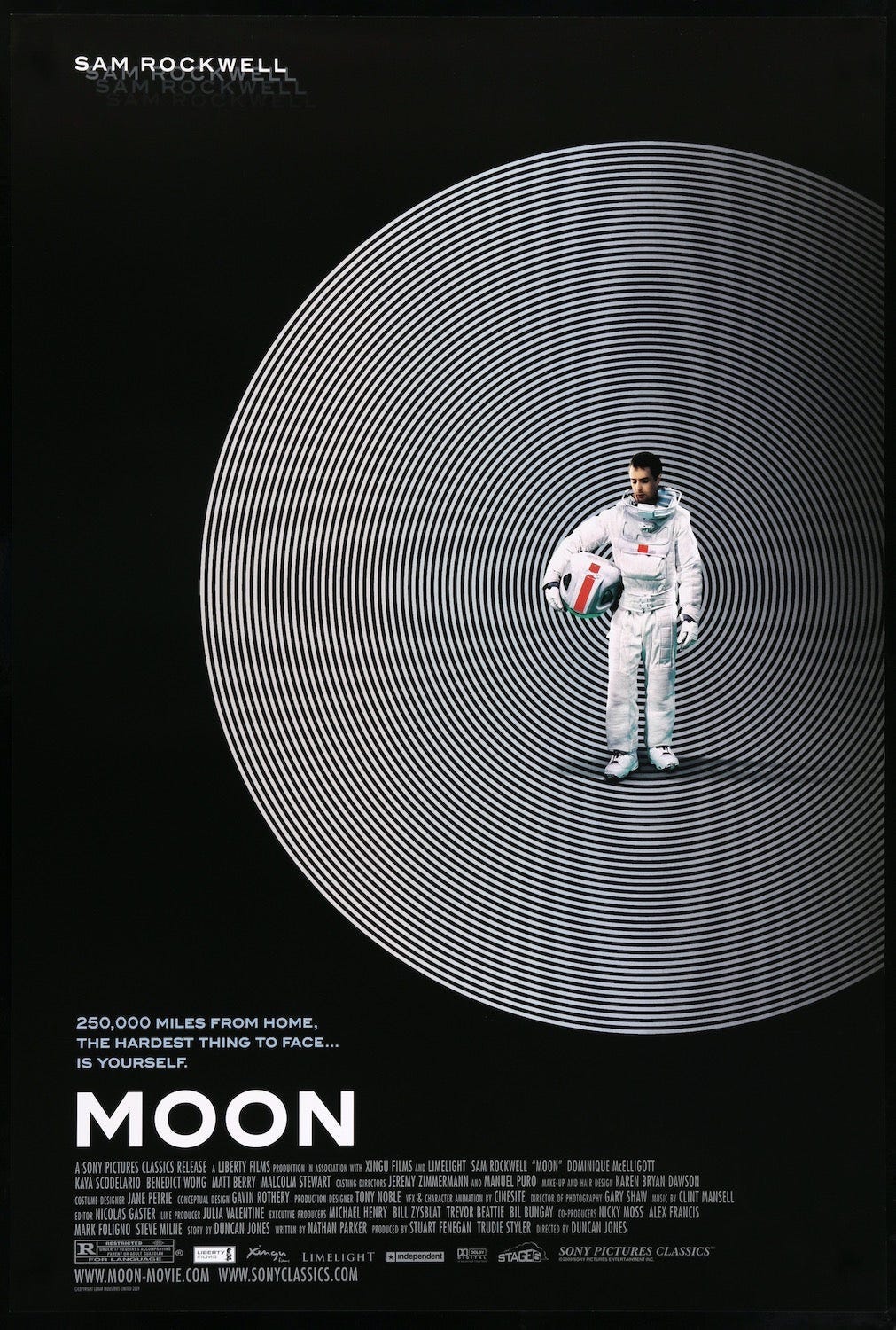
Sam Rockwell plays both versions of Sam Bell as distinct characters. Different posture, different silences, different relationship to a coffee mug. At no point does it feel like a technical exercise. It just feels like two guys sharing the same face. One is physically deteriorating but still finds comfort in his routines, his plants, and the belief that his three-year sacrifice means something. The other has achieved a kind of terrible enlightenment. He understands exactly what he is, how little control he has over his fate, and what the system that created him truly thinks of him. The first Sam’s body is failing. The second Sam’s worldview has collapsed. Rockwell makes both men equally compelling, elevating the dual-role gimmick to a level of performance you don’t often see.
The base looks like an offshore drilling platform designed by someone who read the minimum OSHA requirements and then went home. Jones grew up on Alien and Silent Running, and the fingerprints are everywhere - gorgeous, practical models, industrial textures. Nothing is designed to impress you. Everything is designed to convince you. You believe in the base because it feels used and functional rather than futuristic. And Gary Shaw shoots that fantastic set like a prison. The corridors are narrow, the ceilings feel low, and frames often isolate Sam in negative space or trap him within geometric compositions. The same hallways, rooms, and routines become increasingly unsettling as Sam’s understanding of reality begins to fracture. The camera rarely has the freedom associated with science fiction. It stays confined because Sam is confined.
Moon understands that dehumanization doesn’t arrive wearing a villain’s cape. It arrives disguised as optimization.
Clint Mansell’s score avoids grand orchestral science-fiction music, relying on repetition, minimalist piano figures, electronic textures, and slow-building motifs. Rather than emphasizing wonder, it emphasizes loneliness and melancholy. It feels familiar, like I’ve heard it before in some place I’ve long forgotten, which turns out to be exactly the right feeling for a film about a man who keeps waking up uncertain about what is going on after spending three years talking to his pants on the far side of the moon.
Bolstering the score, the sound design embraces silence rather than filling scenes with machinery and alarms. We hear ventilation systems, distant mechanical hums, and the base's ambient emptiness. The quiet reinforces Sam’s isolation and gives the audience very little emotional protection from what the Sams are experiencing. It’s done so well you don’t really notice it until something big happens, like the harvester crash. That’s brilliant sound design and remarkable restraint in late-2000s science fiction.
Less a meditation on cloning ethics, which was a hot topic when the script would have been penned, Moon is really about labor. Sam is a worker whose value is measured entirely by his productivity. His employer has found a way to extract every ounce of usefulness from him while eliminating the inconvenience of treating him like a human being. Nobody gives a speech. There’s no mustache to twirl. Just enough distance between the decision and the consequence that nobody in the chain ever had to feel anything. The technology is almost incidental. The arrangement is the point, and in 2009, that read as science fiction. In 2026, we live in a moment when algorithms make hiring decisions, AI creates barriers in customer service, and companies increasingly seek efficiency through abstraction. The people making those decisions rarely see the human beings on the other side. Moon understands that dehumanization doesn’t arrive wearing a villain’s cape. It arrives disguised as optimization.
It’s enough to make me want to vomit blood, too, Sam.
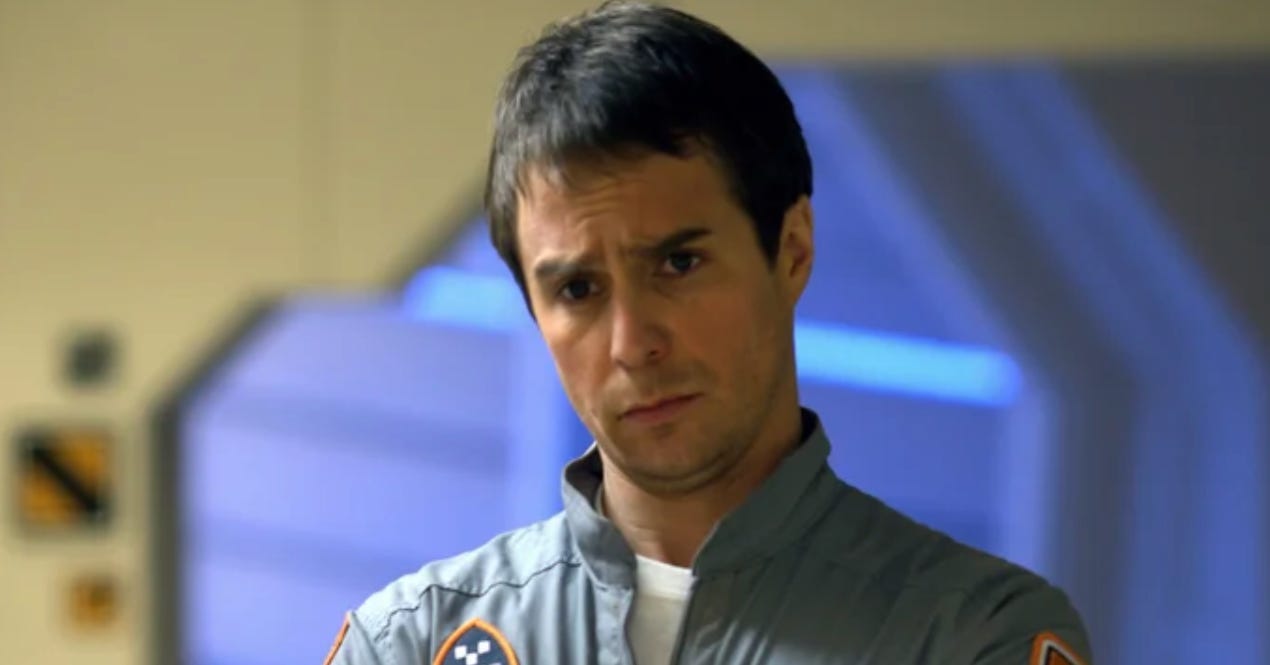
Moon is available on 4k UHD from Amazon.*
*Note that Justin Parlette or Happy Underground Productions may earn a small percentage of sales made through links to products on this Substack.